← Back to projects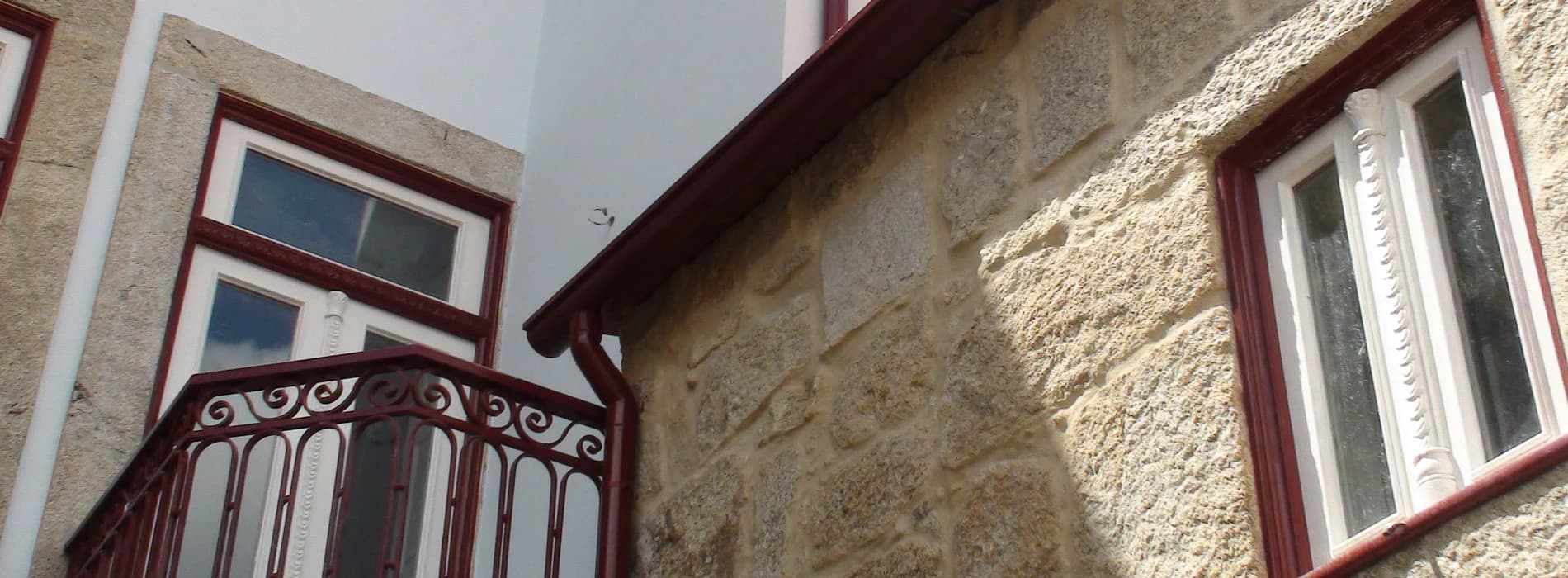
Renovation & RepurposeResidentialProject & Construction
Building in ruins rehabilitated and converted into 4 duplex apartments
<p class="leading-7 [&:not(:first-child)]:mt-6">Located in front of the <strong>Faculty of Law of the University of Porto</strong>, the building — dating from the early 20th century — was identified by a company specialized in <strong>urban rehabilitation investment (buy-to-let)</strong>, which recognized its potential for the housing market.<br>The architectural project was developed with this purpose in mind: <strong>to preserve the building's identity while simultaneously qualifying it as a solid and sustainable real estate product</strong>.</p><p class="leading-7 [&:not(:first-child)]:mt-6"></p><h2 class="scroll-m-20 text-xl font-semibold tracking-tight first:mt-0">The building and its context</h2><p class="leading-7 [&:not(:first-child)]:mt-6">The building presented itself as an opportunity to enhance the built heritage, with unique architectural elements — such as the <strong>skylight over the staircase</strong>, the <strong>rear courtyard</strong>, and the <strong>potential of the attic spaces</strong>.<br>These elements, of undeniable character, were <strong>reintegrated and reinterpreted</strong>, becoming the protagonists of the new residential project.</p><p class="leading-7 [&:not(:first-child)]:mt-6"></p><h2 class="scroll-m-20 text-xl font-semibold tracking-tight first:mt-0">The project</h2><p class="leading-7 [&:not(:first-child)]:mt-6">The building was <strong>converted into four duplex apartments</strong>, with <strong>T1 and T1+1 typologies with an exterior courtyard</strong>, designed to offer <strong>efficiency in the use of available space, comfort, and brightness</strong>.<br>Each apartment is <strong>unique</strong> in its <strong>solar exposure</strong>, in its <strong>relationship with the street and surroundings</strong>, and in its <strong>articulation with the courtyard and the urban horizon</strong> — resulting in distinct but coherent residential experiences.</p><p class="leading-7 [&:not(:first-child)]:mt-6">The adopted architectural solutions sought a <strong>balance between functionality and character</strong>, absorbing and reinterpreting <strong>period details</strong> that add identity and quality to the interior spaces.<br><strong>Thermal and acoustic comfort</strong>, as well as <strong>safety and energy efficiency</strong>, were determining criteria from design to execution, ensuring <strong>low operating costs</strong> and <strong>high performance over time</strong>.</p><p class="leading-7 [&:not(:first-child)]:mt-6"></p><h2 class="scroll-m-20 text-xl font-semibold tracking-tight first:mt-0">Execution and construction efficiency</h2><p class="leading-7 [&:not(:first-child)]:mt-6">The project was <strong>conceived, guided, and detailed</strong> to be executed with <strong>technical efficiency and rationality of means</strong>, allowing for <strong>phased intervention by teams of artisans specialized in traditional rehabilitation</strong>.<br>This strategy ensured <strong>cost control, optimization of construction time</strong>, and a <strong>quality of execution aligned with the project's rigor</strong>.</p><p class="leading-7 [&:not(:first-child)]:mt-6"></p><h2 class="scroll-m-20 text-xl font-semibold tracking-tight first:mt-0">Result</h2><p class="leading-7 [&:not(:first-child)]:mt-6">The <strong>Rehabilitation on Rua dos Bragas</strong> well illustrates <strong>how architecture can regenerate urban heritage</strong>, meeting the demands of the contemporary market without losing the connection to the building's history and the city's identity.<br>More than four apartments, the project represents <strong>an exercise in architectural efficiency</strong> — where <strong>each construction decision</strong> reflects <strong>a commitment between memory, use, and lasting value</strong>.</p>